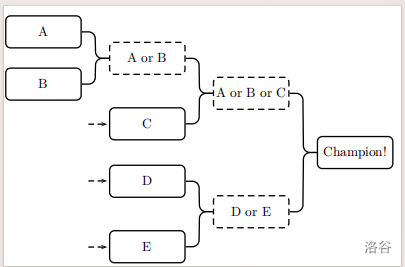
Laura is organising a knockout tournament, in which her friend Dale takes part. Laura would like to maximise the probability of Dale winning the tournament by arranging the games in a favourable way. She does not know how to do it, so she asked you for help. Naturally, you refuse to cooperate with such a deplorable act---but then you realise that it is a very nice puzzle!
When the number of players is a power of two, the tournament setup can be described recursively as follows: the players are divided into two equal groups that each play their own knockout tournament, after which the winners of both tournaments play each other. Once a player loses, they are out of the tournament.
When the number of players is not a power of two, some of the last players in the starting line-up advance from the first round automatically so that in the second round the number of players left is a power of two, as shown in Figure 1.
Figure 1: A tournament tree with players. Players C, D, and E advance from the first round automatically.
Every player has a rating indicating their strength. A player with rating wins a game against a player with rating with probability (independently of any previous matches played).
Laura as the organiser can order the starting line-up of players in any way she likes. What is the maximum probability of Dale winning the tournament?
输入格式
The input consists of one line with an integer (), the total number of players, followed by lines, each with an integer (), the rating of a player. The first rating given is Dale's rating.
输出格式
Output the maximum probability with which Dale can win the tournament given a favourable setup. Your answer should have an absolute or relative error of at most .