Let be a simple undirected graph with vertices and edges, where . A tuple is called as boomerang in if and only if and ; in other words, a boomerang consists of two edges which share a common vertex.
Given , your task is to find as many disjoint boomerangs as possible in . A set contains disjoint boomerangs if and only if each edge in only appears at most once (in one boomerang) in . You may output any valid disjoint boomerangs, but the number of disjoint boomerangs should be maximum.
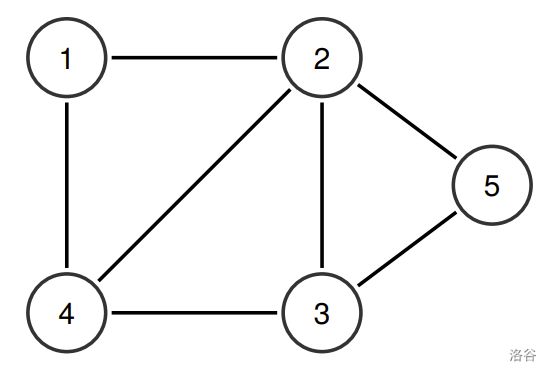
For example, consider a graph of vertices and edges where .
:::align{center}
:::
The maximum number of disjoint boomerangs in this example graph is . One example set containing the disjoint boomerangs is ; no set can contain more than disjoint boomerangs in this example.
输入格式
Input begins with a line containing two integers: (), representing the number of vertices and the number edges in , respectively. The next lines, each contains two integers: (), representing the edge in . You may safely assume that each edge appears at most once in the given list.
输出格式
The first line of output contains an integer: , representing the maximum number of disjoint boomerangs in . The next lines, each contains three integers: (each separated by a single space), representing a boomerang . All boomerangs in the output should be disjoint. If there is more than one valid solution, you can output any of them.

 :::
:::