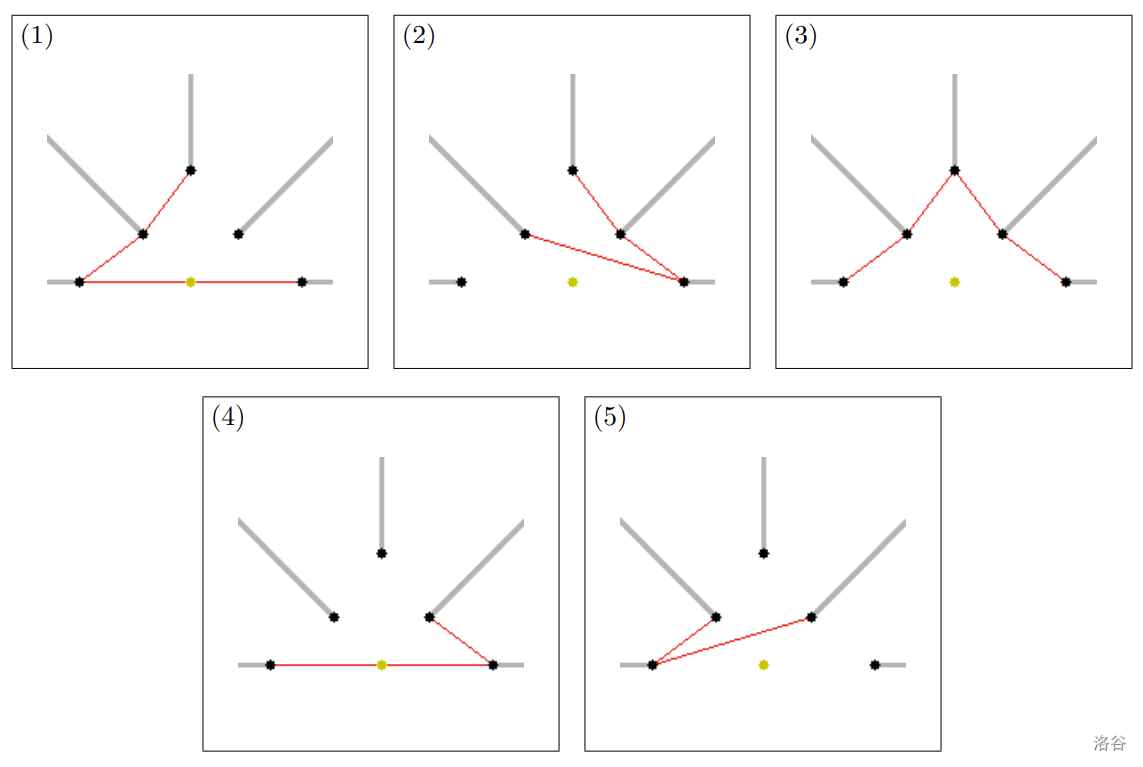
Alice and Bob are playing a game of baggage delivery using a toy solar car. A number of poles are placed here and there in the game field.
At the start of a game, the solar car is placed right next to a pole, and the same or another pole is marked as the destination. Bob chooses one of the poles and places the baggage there. Then, Alice plans a route of the car to pick up the baggage and deliver it to the marked destination. Alice chooses the shortest possible route and Bob should choose a pole to maximize the route length.
The solar car can drive arbitrary routes but, as it has no battery cells, it would stop as soon as it gets into shadows. In this game, a point light source is located on the surface of the field, and thus the poles cast infinitely long shadows in the directions opposite to the light source location. The drive route should avoid any of these shadows.
When the initial positions of the solar car and the destination are given, assuming that both players make the best choices, the length of the drive route is uniquely determined.
Let us think of all the possible game configurations with given two sets of poles, one for the start positions of the solar car and the other for the destinations. When both the initial car position and the destination are to be chosen uniformly at random from the corresponding sets, what is the expected route length?
Your task is to compute the expected value of the route length, given the set of the initial positions of the car and that of the destinations.