:::align{center}
 :::
:::
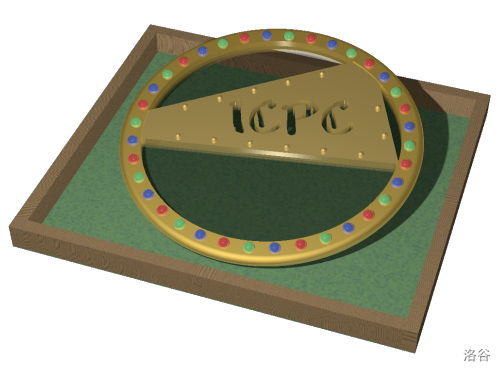
She came up with a new jewelry design. The design uses two parts: a hollow circlet and a convex polygonal component. The design can be customized by specifying the edge lengths of the polygon, which should be multiples of a unit length, so that customers can embed memorial numbers in the jewelry. Note that there can be many different polygons with edges of the specified lengths. Among them, one with a circumscribed circle, that is, a circle that passes through all of its vertices, is chosen so that the polygonal component can be firmly anchored to the circlet.
:::align{center}
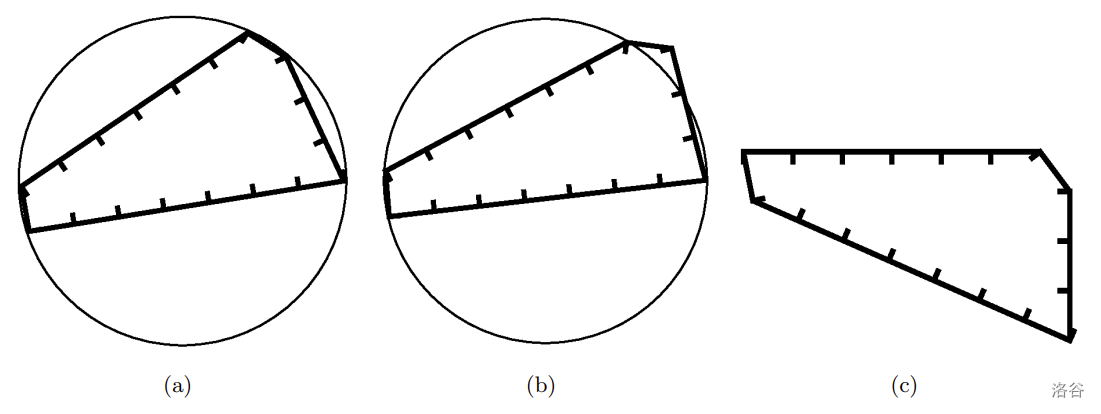
Figure E.2. (a) A pentagon with a circumscribed circle; (b) A pentagon with no circumscribed circle; (c) Another pentagon with no circumscribed circle
:::
For example, Figure E.2(a) has a pentagon with its edge lengths of 3, 1, 6, 1, and 7 units, meaning March 16th and 17th. The radius of the circle is approximately 3.544 units. Figures E.2(b) and E.2(c) show pentagons with the same edge lengths but neither of them has a circumscribed circle.
To commercialize the jewelry, she needs to be able to compute the radius of the circumscribed circle from specified edge lengths. Can you help her by writing a program for this task?
