So, If and Else grow out of each other;
Hardness and Tractability complete each other;
Long int and Short int shape each other;
High bits and Low bits determine each other;
Music and Voice give harmony to each other;
Push_front and Push_back give sequence to each other.
-- Tao Te Ching, Laozi, Zhou dynasty, ancient China.
Translated (loosely) by yours truly.
Given an rectangular grid of rows and columns, each cell can be labeled black (Yin) or white (Yang). Two cells are neighbors if they share a common unit-length edge segment. The grid is valid if all the black cells form a path, and all the white cells form a path. A path is a set of cells defined as follows:
The cells form a connected piece. From each cell in , you can reach any other cell in by moving between neighbors within .
Exactly two cells in have exactly one neighbor in each. These are the "ends" of the path.
Every other cell in has exactly two neighbors in .
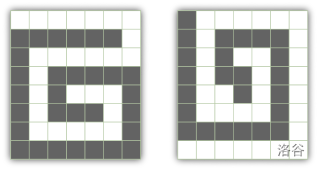
For example, in the picture below, the first grid is valid, while the second grid is not -- although the black cells form a path, the white cells do not.
Given and , compute the number of valid grids. Note that symmetry doesn't matter -- as long as two valid grids differ in one position they are considered different, even if one can be rotated or flipped to the other.
输入格式
The first line of the input will be a single integer , the number of test cases. lines follow, each of which contains two integers separated by a space: " ", as defined above.
输出格式
For each test case, output a line in the form "Case #: ", where is the case number, starting from 1, and is the number of valid grids of the specified size.