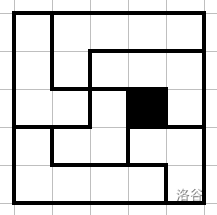
Given a grid with rows and columns, there is exactly one black cell in the grid and all other cells are white. Let be the cell on the -th row and the -th column, this black cell is located at .
You need to cover all white cells with some L-shapes, so that each white cell is covered by exactly one L-shape and the only black cell is not covered by any L-shape. L-shapes must not exceed the boundary of the grid.
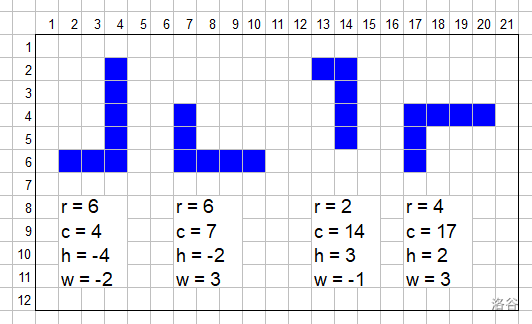
More formally, an L-shape in the grid is uniquely determined by four integers , where determines the turning point of the L-shape, and and determine the direction and lengths of the two arms of the L-shape. The four integers must satisfy , , , , .
If , then all cells satisfying belong to this L-shape; Otherwise if , all cells satisfying belong to this L-shape.
If , then all cells satisfying belong to this L-shape; Otherwise if , all cells satisfying belong to this L-shape.
The following image illustrates some L-shapes.
输入格式
There is only one test case in each test file.
The first line contains three integers , and (, ) indicating the size of the grid and the position of the black cell.
输出格式
If a valid answer exists first output Yes in the first line, then in the second line output an integer () indicating the number of L-shapes to cover white cells. Then output lines where the -th line contains four integers , , , separated by a space indicating that the -th L-shape is uniquely determined by . If there are multiple valid answers you can print any of them.
If there is no valid answer, just output No in one line.