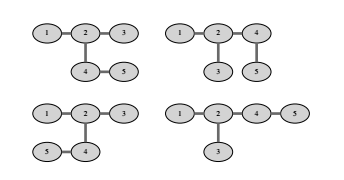
As you probably know, a tree is a graph consisting of nodes and undirected edges in which any two nodes are connected by exactly one path. In a labeled tree each node is labeled with a different integer between and . In general, it may be hard to visualize trees nicely, but some trees can be
neatly embedded in rectangular grids.
Given a labeled tree with nodes, a by embedding of is a mapping of nodes of to the cells of a rectangular grid consisting of rows and columns such that:
Node is mapped to the cell in the upper-left corner.
Nodes connected with an edge are mapped to neighboring grid cells (up, down, left or right).
No two nodes are mapped to the same cell.
Find the number of by embeddings of a given tree, modulo .
输入格式
The first line contains an integer — the number of nodes in . The of the following lines contains two different integers and — the endpoints of the edge.
输出格式
Output the number of by embeddings of the given tree, modulo .
样例
样例输入 1
5
1 2
2 3
2 4
4 5
样例输出 1
4
数据范围与提示
All embeddings of the tree in the example input are given in the figure above.